Pages

Showing posts with label Gasoline. Show all posts

Wednesday, December 14, 2016

EIA Weekly Petroleum Status Report: Spike in Production, Drop in Imports and Demand

Today's EIA Report showed a drop in Crude Inventories (down 2.563 MMBBL), a sharp rise in Lower 48 Production (up 101 KBBL), and a dive in net imports (just 3.6 MMBBL).  The 4 week moving average of gasoline demand also fell, continuing the downward trend and below 2015 levels.

See 11 graphs below:


Thursday, June 26, 2014

EIA Weekly Petroleum Report: A Weaker Picture this Week

EIA reported increases in crude, gasoline, and diesel inventories this week.  Overall, stocks remain high for crude, average for gasoline, and low for distillate.


Regionally, stocks increased in the closely watched Cushing, OK storage region and the gulf coast, leaving Cushing well below the historical range, and gulf coast well above.


Demand showed weakness in both gasoline and diesel, with weekly gasoline demand falling below the 5 year range, and distillate falling for the 4th week in a row to the middle of the range:


Sunday, May 25, 2014

DOT Traffic Volume: Slightly Up Year on Year in Weather-affected March

DOT Federal Highway Administration released its Traffic Volume Report for March 2014.  It shows a very slight increase in total miles vs March '13, though this year was likely to be impacted by severe weather, so growth is anticipated in April.  This is confirmed by the EIA weekly reports of gasoline supplied, which have shown solid growth in each of the last 11 weeks, save one.  Combined with the long term trend in improving fuel efficiency, this suggests traffic is generally growing.


DOT Traffic Volume:


EIA Gasoline Supplied:

Friday, March 28, 2014

Average New Vehicle MPG rises again in FEB

The University of Michigan reported  fuel economy for FEB 2014 new car sales, which rose to a new highs.
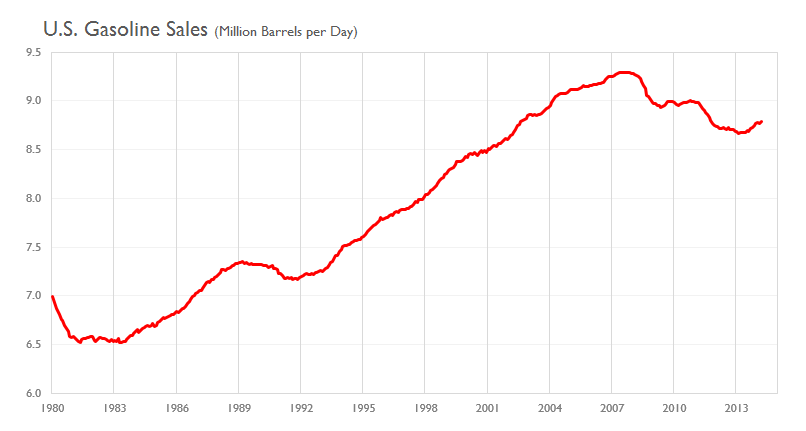
Since total miles driven has remained flat for almost four years now, the rapidly improving fuel economy of new vehicles should increasingly result in lower domestic gasoline consumption.  US gasoline sales have reflected this so far (see the 12 month average gasoline sales graph below).  But alternatively we may also see an increase in miles driven, as employment picks up and the economy improves generally.


Wednesday, March 26, 2014

Miles Driven in January Declines to Lowest in 3 Years

DOT statistics for miles driven in January 2014 were released this week, and showed a significant decline in total miles driven, month-to-month and year-on-year.  The weather was such a significant factor that it is difficult to discern any other trends.


  • Miles driven in January were down about 3 percent from the prior Jan, and the lowest in three years.
  • The trailing 12 month average miles driven was up slightly.
  • The trailing 12 month average also continues to show a very slight trend toward more highway miles and fewer 'other' miles.


The 12 month average:


Wednesday, March 19, 2014

EIA Petroleum Inventory: Crude +5.85M (Cushing -1.0M) Gas -1.47M Diesel -3.1M

INVENTORIES
Today's EIA Petroleum Weekly Report saw crude inventories rise sharply while all product inventories were down (excepting Propane).  Cushing inventories fell again, and are now 100K barrels below the 5 year minimum for this date.


Cushing
The reversal of the Seaway pipeline is having its intended effect on Cushing, OK crude inventories.


SUPPLY
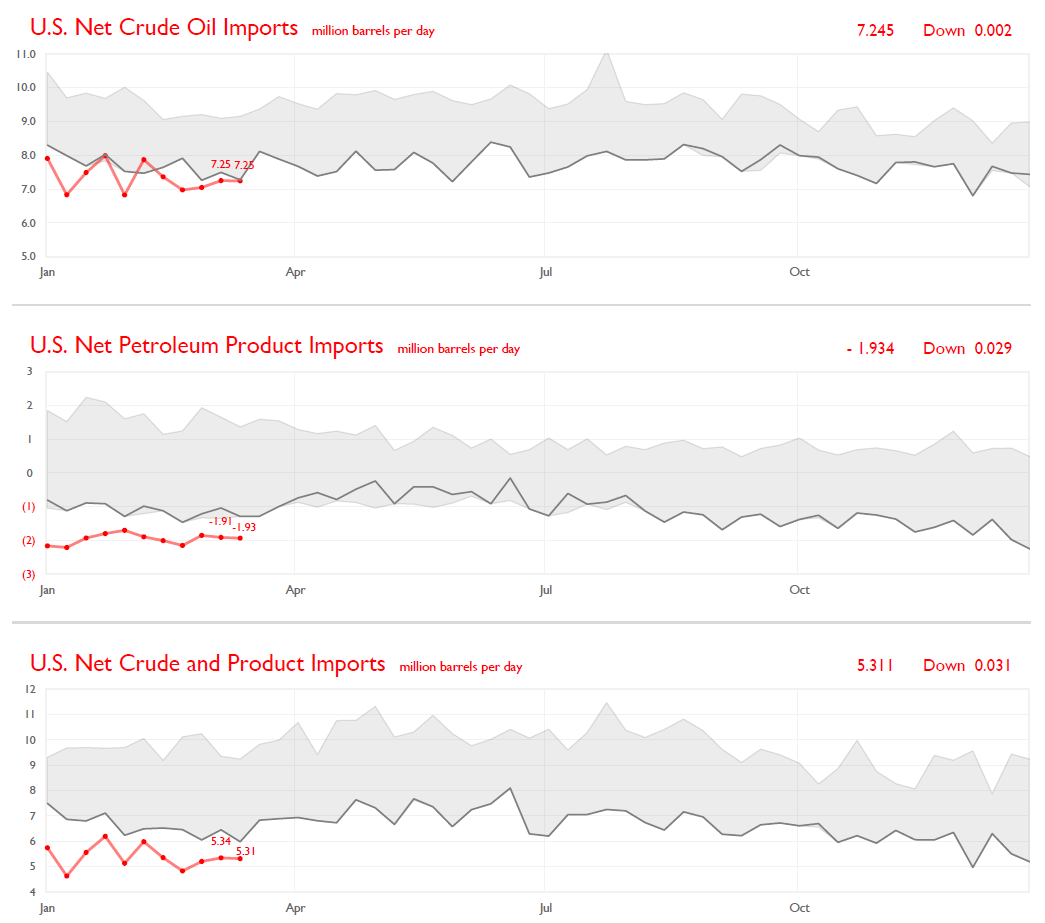
U.S. Crude production rose again this week, by 33K BOPD, to a new high of 8.22M BOPD.  The trade balance was little changed, as crude imports were steady week on week, and product exports rose slightly:


DEMAND
Implied demand saw a large decline in gasoline after a comparably steep rise last week.  Diesel demand rose by 462K BPOD to 4.16M, above the 5 year range.


PDF Reports:
EIA Weekly Petroleum Demand


Wednesday, February 26, 2014

EIA Weekly Petroleum Status Report

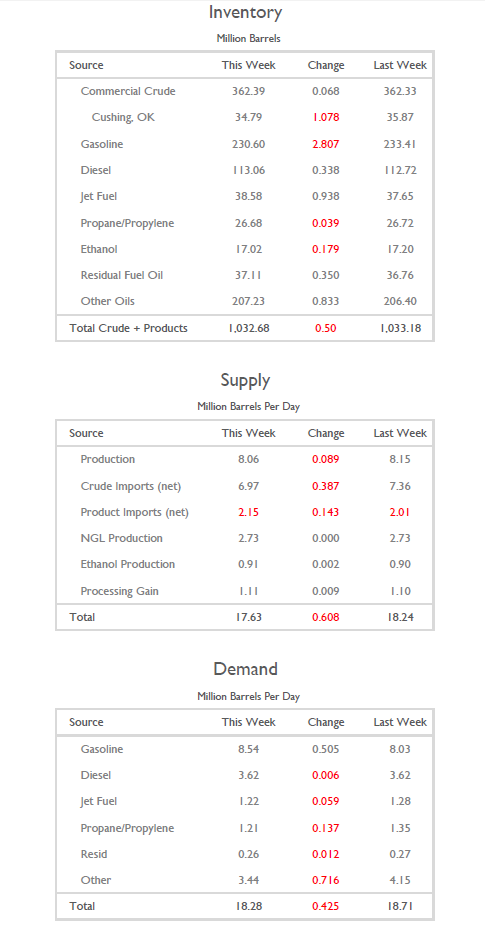
Today's EIA Petroleum Status Report was notable for continued declines in oil inventories at Cushing, OK (down 1.078 MMBBL) as well as improvement in the trade balance with crude imports declining and product exports up.   Mild weather also took the pressure off of propane, reducing demand and holding inventories nearly flat (down just 39K Barrels).  Crude production also fell, with declines in both Alaska and the Lower 58.


Monday, February 24, 2014

Gasoline Consumption: Driving Trends and Efficiency Trends

The great recession in the US coincided with changes in consumer behavior that were unexpected, and to some extent still not explained.  For decades, GDP growth and population growth were closely correlated with the lightbulb and the car....Americans drove more miles nearly every year, and used more electricity.
Now those correlations have been broken.  Considering transportation specifically, analysts are publishing research on megatrends that attempt to explain the fact that cars are not returning to the road.  Several variables have been implicated:
  • Urbanization
  • Work force participation
  • Demographic shifts
  • Technology
  • Changing attitudes
  • Lifestyle changes

Whatever the cause, and if such a trend continues at all, the second order question for the energy sector is the impact on fuel consumption.  This requires consideration of fuel economy trends as well.  

A high level perspective may be helpful in separating the major issues from the minor ones.  The DOT recently released vehicle miles data for December 2013.  Because there is high seasonality, and weather sensitivity in winter, it isn't safe to conclude much from monthly data, but in general the release is consistent with a low/no growth trend in miles driven.  


Further analysis of the details indicates that interstate driving (both urban and rural) has been trending down vs arterial and surface street driving, but only slightly.

Most of the underlying trends that are blamed for the stagnation in miles driven are unlikely to reverse.  The primary exception is workforce participation, which is at historic lows and could recover substantially.  

The trends in fuel economy are also inexorably toward higher efficiency.  Wide variations in estimates for mpg improvement are muted by the slow penetration rate of new vehicles into the large existing vehicle count, and by the longer life of newer vehicles.  Projections also require assumptions about the future price of gasoline, adding uncertainty.  

Here are a few relevant data sets.


Observations:
  • Average mpg increase from 1990 to 2006:   +2.2 mpg (not much)
  • New car mpg increase from 1990 to 2006:   +2.1 mpg  (not much)
  • From 2006 to 2012, new car mpg increased +4.5 mpg (much)
  • The impact on fuel consumption, if average mpg rose by 4 mpg, would be a decline of about 1.2 million barrels per day of gasoline, or about a 15% decline.
So without speculating too much, the fact that mpg is improving at an increasing rate plus a 5 year stagnation in miles driven does suggest that unless Americans begin hitting the road again soon, the gasoline consumption trend has to head downward and could decline a long way.  

Naive logic suggests that a few other points may be axiomatic:

  • If one drives very little, mileage is a less relevant cost of ownership
  • If one drives very little, a vehicle could last half of one's driving lifetime
  • If gas taxes pay for road construction and maintenance, increased taxes may be required to maintain revenue.  That could become a self reinforcing cycle that keeps gas prices high in a variety of scenarios.
  • Energy independence, from a liquid fuels perspective, could be achieved even in a domestic peak oil scenario.


Friday, February 14, 2014

Gasoline Sales in Mexico

For a developing economy with high GDP and population growth, Mexico is not following the fuel intensive trajectory of China.  Since Pemex has a monopoly on fuel sales, the monthly sales data is well consolidated.

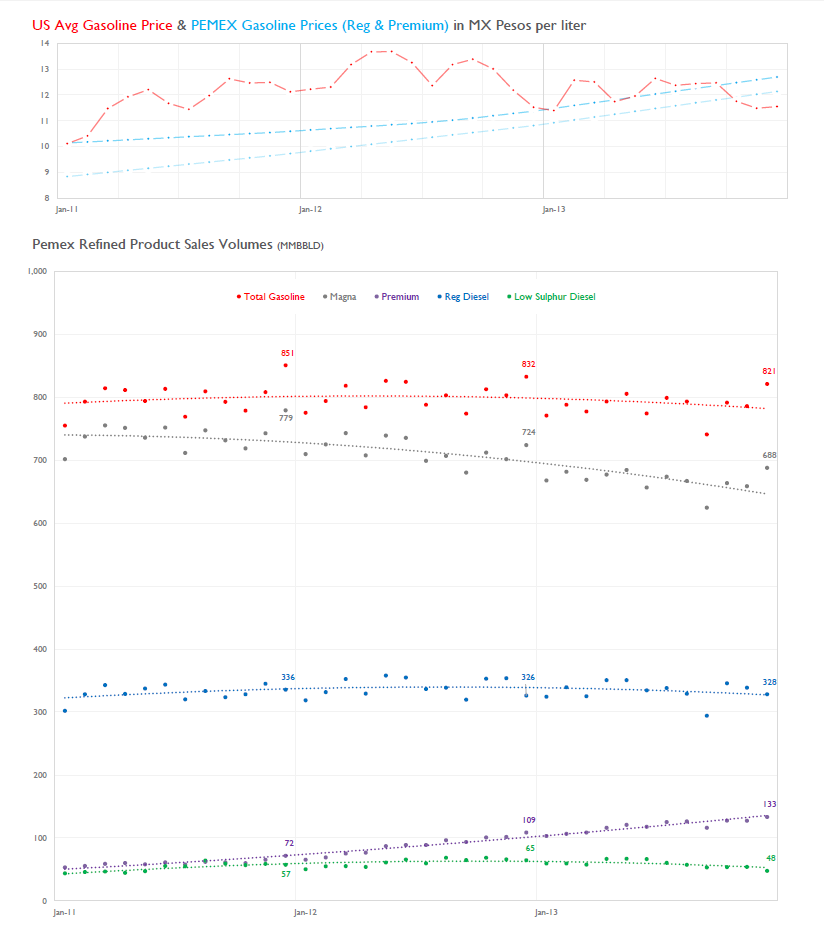
Here is a look at two data sets:

Gasoline Prices:  While the EIA average on-highway gas prices in the U.S. have fluctuated in the past three years, overall there is no upward trend (when converted to Pesos).  But in Mexico, there steady monthly retail price increases.

Gasoline Sales:  These are the monthly retail sales volumes for a variety of fuels in Mexico.  If anything there is a downward trend in overall gasoline sales (though premium grade is gaining market share).