Pages

Showing posts with label natural gas supply. Show all posts

Tuesday, July 11, 2017

Texas Railroad Commission Reports Rise in Drilling Permits for June '17

The Texas RRC released its drilling, completion, and permitting statistics for June this week.  Total new permits topped 1,200 for only the second time in years, with combo (oil+gas) and oil wells leading the charge.  Gas well permits were also up, but only represented 70 of the permits issued.


It's notable that new well completions still have not begun to follow the upward trend in permitting.  Whether that is tardy reporting, or maybe DUC count is rising, it suggests that unless many of these permits are being delayed or abandoned, we will eventually witness a surge in completions, and therefore production.

Gas new-drill completions reported in June were just 68, and oil completions were 446:


Friday, May 12, 2017

Haynesville Shale Production Turns Upward Again

The Louisiana state oil and gas reporting system shows well by well production, usually about 3-5 months lagging.  Based on the operators who have reported monthly production, February shows the first significant uptick in production after a long decline and plateau.  All the gains are in De Soto Parish, in fact.

With the rapid rise in working rigs, the Haynesville is likely to see gains for some time, perhaps returning to it's 7 BCFD glory next year if activity continues ramping up.  


Monday, May 8, 2017

Texas Oil and Gas Well Permitting Activity Declines in April

Despite relentless increases in rig counts, Texas RRC reporting a decline in well permitting in April.

Combination Oil/Gas well permits declined from 893 in March to 576 in April.
Oil well permits declined from 284 to 223.
Gas well permits declined from 56 to 55.


Tuesday, April 18, 2017

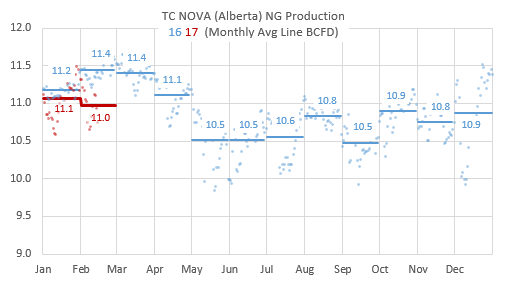
Alberta Gas Production Rises in April, Averaging 0.2 BCFD Above April '16.

Whether seasonal factors and timing, or a fundamental shift is taking place, TC Nova pipeline receipts in April are up from Feb and March, and are now above 2016 levels.

Output normally declines in May, and we will soon see whether the same pattern prevails in 2017.  If the higher rig counts are translating into more molecules, it could reverse the inventory trend we have seen since January:


Monday, April 10, 2017

Texas Drilling and Permit Activity: Drilling Steady, Permitting Way Up

Completions have not yet accelerated, but permitting really took off in March, per the Texas Railroad Commission Drilling, Completion, and Permitting Report for March 2017:

Permits issued in March rose to 1,233 from about 930 in each of the three previous months (Mostly Oil permits, fewer Oil+Gas permits, and very few Gas permits:


Only 63 gas wells were completed in March.  Oil activity was much greater, at 475 new well completions, but still well below March 2016 (876 completions).


Monday, March 13, 2017

Western Canada Natural Gas Storage Surplus Eliminated

A combination of colder weather, higher exports, and lower production have more than eliminated the 40 BCF surplus that western Canada started the year with.  It is now a growing deficit, though weather is moderating quickly from here on out and the big daily storage draws should be history by mid-week.


Friday, March 3, 2017

Alberta Gas Production Level at 11.2 BCFD, Storage Withdrawals Strong

Field receipts on the TC Nova system in Alberta have been near 11.2 BCFD for the last 12 days, which is around 1/4 BCF below last year's average for the same period.  

Meanwhile, year to date withdrawals from storage total 58 BCF, far exceeding last year's 17 BCF.  This brings western Canadian storage to about even with last year, as a 40 BCF surplus at Jan 1 has been worked off.  Cold weather should be moderating in the province this week, so likely the storage withdrawals will ease back and we may see the beginning of injection season, since gas demand south of the border will also be very low after this weekend.


Saturday, February 25, 2017

Why is the Natural Gas Forward Strip Price Cheap and Getting Cheaper?

Even though it seems impossible that our government could issue such a forecast, here is the February Short Term Energy Forecast for Natural Gas Marketed Production.  It projects that just 22 months from now, production will rise from 76.9 BCFD to 85 BCFD.  That seems far fetched, but it may not be far from consensus.  If this prevails, we will see low $2 gas in all likelihood.  But I don't consider it likely that we will hit these production milestones.  

Anything close to these output levels will devastate the gas market.  There is no outlet for this gas beyond slight upticks in LNG capacity, and a mild, 1 BCFD increase in pipeline exports to Mexico.


However, the EIA has made large downward revisions recently to it's forecasts.  Here is the same forecast shown above, but with the same actual/forecast estimates from Aug '16 (6 months ago).  The Feb '17 production forecast has dropped by 3.2 BCFD!


Friday, February 17, 2017

Haynesville Shale: Rig Counts Rise +3 to 34, vs 15 Last Year. Gas Production Outlook?

Rig counts have been steadily rising in the Haynesville Shale for a very long time now.  The production response has been muted/sluggish/nonexistent thus far.  

Louisiana has a well production reporting system that has a 4-5 month lag before data is substantially complete, so November '16 is solidifying now, and it shows a slight uptick in daily production, though the plateau in output that prevailed for the prior 15 months hasn't been decisively broken.  

The two parishes that contribute the lion's share of output (70%), Caddo and DeSoto, are shown below as well.  The long lag in reporting makes this data fairly backward looking, but even so.  


Thursday, February 16, 2017

Western Canadian Gas Production Continues to Falter

Despite the year-on-year higher rig counts, receipts on the TC Nova system have been averaging well below last year, and storage draws on the system reflect that as well.  A few more weeks of this and the storage surplus will be eroded.  


A close-up of the same data:


Friday, January 27, 2017

Alberta Natural Gas Production Recovers, But Storage Falls Faster Than Last Winter

By this date in January last year, 21 BCF had been withdrawn from storage on the TC Nova system.  This year, 31.5 BCF has been removed.  In part that can be explained by weather, but it's also partially due to production shortfalls early this month.  


Daily production dipped to about 10.6 BCFD on the 11th, and has been recovering since.  In the recent week, receipts were comparable to last year, and brought the month's average up above 11 BCFD, which is 200 MMCFD below last year's average for January.  That gap should close further in the last few days of January, but production must increase further to keep pace with last year's 11.4 BCFD average for February:

Rigs Counts Surge Higher: Oil +15 Gas +3

The US oil rig count rose 15 to keep the drilling revival on trend, confirming that the current oil price environment in the $50's is enough to generate strong returns, especially in the Permian, SCOOP, and Eagle Ford.

The gas rig count rose more modestly, with the Haynesville adding 2 of the 3 rigs.


The Canadian oil rig count rose by 7, to a strong 200 rigs.  And the gas rig count dropped by 4 but remains close to a 2 year high:


Friday, January 20, 2017

Steep Rise in Rig Counts: Oil +29 Gas +6

After a lull over the holidays, rigs were added in bulk this week.  Oil rigs were up 29, returning the rig count to the trend line that began last May.  Most of the rigs were added in the Permian (+13), with the Williston also showing signs of life at +3.  Cana Woodford also added 9, pushing the count to 46 in that basin.  


The Canadian rig count continues to astound, with 23 more oil rigs added, and 5 gas rigs.  Both those fleets are now back to where they were in early 2015.

Wednesday, January 18, 2017

Alberta Production Recovers Slowly, Storage Withdrawals Moderate

The year began with a bang, as cold weather, lower production, higher exports, and easy year-on-year comparisons saw the TC Nova surplus storage situation improving rapidly.  Now the warm north american weather has mitigated all those factors, and production is recovering above 11 BCFD, while storage draws have declined to near zero (-114 MMCF yesterday):


Friday, January 13, 2017

Rig Counts: Oil Rigs Down 7, Gas Gains 1. Sharp Rise in Canadian Oil & Gas Drilling Activity

Holiday effects might be dampening the upward trend in US oil drilling, which was down 7 this week.  As for major basins, Barnett lost an oil rig, Eagle Ford gained 1, Granite Wash lost 1, Permian gained 1, Williston lost 1.

Gas rigs were up 1.  Nonmajor plays added 5, so the net effect was a decline in drilling potential.  Utica and Marcellus each lost 1 rig.  Haynesville and Eagle Ford both lost a single gas rig as well. 


Canadian rig counts surged on post holiday seasonality, pushing both counts to the highest in almost two years:


Monday, January 9, 2017

Texas Drilling and Completion Activity in December: Oil Gains, Gas Loses

The Texas Railroad Commission reported December drilling, completion, and permitting activity today.  It showed a sharp increase in well permits, and a rise in reported new oil well completions.  Gas completions, however, hit a new low at just 75 new wells:


Oil completions rose from 264 to 384, along with oil rig counts and prices:

Alberta Natural Gas Production and Storage Remain Tight Year-on-Year

Whether due to cold weather or other variables, the step-down in TC Nova natural gas output in the new year continues.  After hitting a one day peak above 11.5 BCF, output has been averaging about 10.9 in January.


Higher demand, and exports to the US, are pulling more from storage, and the 50 BCF surplus that began the year is shrinking steadily.  Daily withdrawals have been more than double prior year amounts, resulting in a 7 BCF reduction in the surplus through nine days of January:


Friday, January 6, 2017

Rig Counts: Oil +4 Gas +3

Rig counts rose modestly this week, according to Baker Hughes.  Both oil and gas rigs continued the trend lines established last summer.  Oil rigs rose by 4 to 529, with gains in the Permian (+3) and Eagle Ford (+1).  

Gas rigs rose by a net 3, with major basins gaining:  Haynesville (+2), Utica (+1) and Marcellus (+1).


In Canada, the post holiday drilling recovery began in earnest, with oil rigs up 29 this week after falling by 54 in the prior week.  Gas activity was stronger, with a bounce to a new year high.  Gas rigs were up +23 to 123 after falling by 13 last week:


Tuesday, January 3, 2017

Alberta Natural Gas Production and Storage Tighten in 2017

Cooler weather and the end of the holidays has seen the Alberta TC Nova system reporting reduced production volumes and larger withdrawals from storage compared to last year in the early days of 2017.

High daily receipts, near 11.5 BCFD, were seen in the last week of 2016, but the first two days of January averaged 11.1 BCFD, down 0.4 BCFD.  Jan-Feb-Mar are seasonally high months, and the rising rig count should translate into some biennial daily high receipts in the coming weeks.


On the storage front, the withdrawals in the first two days of the year averaged over 1.2 BCF, more than double last year.  Two days does not a trend make, and weather is colder than normal, but the nightmare of last year's excess storage volumes looks unlikely to be repeated (Net withdrawals in Jan-Mar of last year were zero!):


Monday, January 2, 2017

EIA Reports OCT Natural Gas Production

On Friday The Energy Information Administration issued its Natural Gas Monthly Report for October.  Dry production was down 1.18 BCFD from the previous month, to 70.69 BCFD.  That is 3.43 BCFD below the same month in 2015.  


Dry production has been falling faster than gross production, because more liquids are being stripped out.  The percentage of gross production that is being removed as NGLs has been rising, and is up from about 5.3% a year ago to about 5.9% now: