Many are predicting an end to the steady production growth from PA, but with rig counts near all time highs, and longer laterals every year, this does not seem likely.
The April 15th EIA Drilling Report on the Appalachia Region shows the continuation of a trend that has reshaped the north american gas market:
Friday, April 26, 2019
Thursday, April 25, 2019
Natural Gas Storage Continues Recovery
Natural Gas Inventory rose +92 BCF last week, continuing its aggressive recovery. It's a shocking contrast to last year's 34 BCF DRAW. This build brings the deficit to the 5 year average down to -369B, after bottoming out at -565B about eight weeks ago.
The consensus is for a strong early injection season, then quickly weakening as exports (primarily LNG) ramp up in the latter half of the year.
Wednesday, April 24, 2019
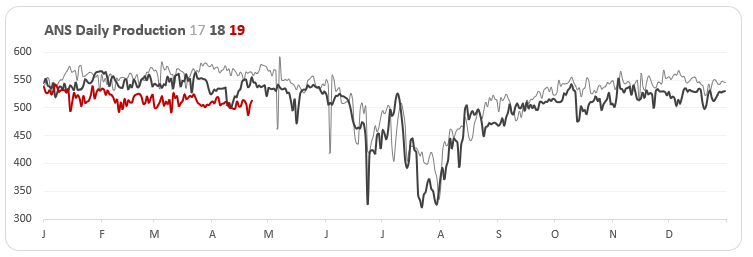
Alaska North Slope Crude Oil Production: Steadily Declining at 4%+
With maintenance season approaching, crude output on the north slope continues a steady long term decline.
The trailing 12 month average is down more than 20K over the last year, breaking through 500K BPOD this week:
Daily output fluctuates a lot, especially in Summer, but the trend is visible:
The trailing 12 month average is down more than 20K over the last year, breaking through 500K BPOD this week:
Daily output fluctuates a lot, especially in Summer, but the trend is visible:
Tuesday, April 23, 2019
Miles and Mileage: Driving Grew Faster than Fuel Economy Improved
With yesterday's release of traffic data for January, here's a look at the long term traffic and fuel economy trends in the US. In 15 years, with the GFC conspicuous mid-decade, miles driven has increased 8-9%, to about 3.23 trillion miles per year. Over the same period, fuel economy (a crude measure using unleaded fuel demand vs miles driven) has improved minimally (about 6-7%) to about 22.5 MPG.
New cars aren't poised to lift the average so very much:
"(Reuters) - The fuel economy of new U.S. cars and trucks hit a record 24.7 miles per gallon in the 2016 model year..."
New cars aren't poised to lift the average so very much:
"(Reuters) - The fuel economy of new U.S. cars and trucks hit a record 24.7 miles per gallon in the 2016 model year..."
With miles driven growing faster than fuel economy improves, total fuel consumption goes up axiomatically. But common sense suggests that a combination of slower population growth, fuel economy improvements (and mandates), and slower GDP growth, plus the wild card of ride sharing, should influence this trend.
This graph is low resolution to begin with, and I've done some smoothing, but everything is built on EIA and DOT data, in Miles per Gallon of Unleaded, and Trillion Miles Traveled per Year.
Monday, April 22, 2019
Nuclear Power Rebounds in April
The Spring refueling season for nuclear reactors is peaking now, and units are beginning to return to service. The net effect is about 3.5 BCFED currently offline, which is about 0.75 BCFED less than '18. This refueling season peaked a little lower, and a little earlier, so we should see a steady return to service of the remaining offline reactors.
Outages were heavy in the Autumn, and so year-on-year comparisons favored increased natural gas utilization, but the situation has now reversed sharply and suddenly.
Subscribe to:
Posts (Atom)