Pages

Thursday, November 3, 2016

Renewable Energy Marketshare in California Growing

With several megawatts of new Solar PV set to come on line by year end in California, the state embodies the struggle between Renewables and Natural Gas, the 'frenemies' of the clean power generation market.  

Solar capacity rose substantially this year already, with daily peak generation above 8GW on most days.  Hydro is also up due to rainfall of late.  As November begins, renewables are taking an ever larger bite out of the pizza.  Here is CAISO marketshare for NOV, Year on Year, showing that Renewables+Hydro is up over last year.  (Wind is the largest contributor to daily volatility in this measurement).


Because total generation hasn't changed much YOY, this reduces the call on natural gas generation.  Further exacerbating that situation is the heavy Columbia River streamflow, which is sending more renewable imported power to CA, for now.  


Wednesday, November 2, 2016

Warm Beginning to Winter, Quantified

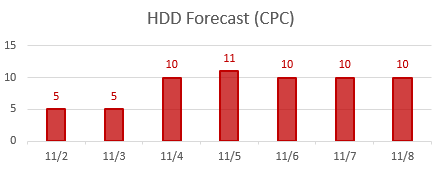
Heating Degree Days, per the CPC, are off to a poor start, and the forecast is also grim in the near term.

In short, the gas-weighted HDD total through last Saturday was just 197, against a 371 norm.  That's about half (53%) the normal heating load.  Last year was also weak, at just 263.


By week, here is what we've seen since the beginning of September:


The forecast is no better, with the current 7 day forecast totaling a mere 61:


Monday, October 31, 2016

Western Canada Natural Gas Production Outlook

The TC Nova system in Alberta handles around 80% of Western Canada natural gas production and storage, and their handy daily postings are helpfully transparent.  Those who track rig counts may have noticed the high natural gas rig count in Canada, relative to production, over the past year.  

Last week's Baker Hughes rig count report showed 79 gas rigs in Canada vs 114 in the US.  But 2016 average daily production of marketable natural gas has been about 80 bcfd in the US vs 15 bcfd in Canada.  That's a 4:1 production ratio on a 3:2 rig ratio.

Alberta production has been averaging about 0.4 bcfd over prior year recently, but it's expected to begin moving higher.  Domestic demand is also rising there, with around 0.3 BCFD of incremental demand from oil sands processing expected in 2017.  

AECO Hub and TC Nova storage inventories have recently received special attention, as seasonal inventory peaks and a general excess of gas in the west is impacting pricing and volatility.  That should be behind us now, as daily storage draws are now the norm and should continue through winter.


Friday, October 28, 2016

Haynesville Shale Attracts Gas Rigs Again

This week's rig count marks the fourth week of increasing rig power in the Haynesville, confirming that a low $3 forward strip is attractive to some producers.  


Gas output from the HS has been on a shallow decline since the end of 2013, falling from about 4BCF to 3.5BCFD, after a sharp 2-year decline from 7.2 to 4.0 BCF in 2012-13.  The drilling improvements recently reported by Chesapeake suggest that a horizontal rig count >20 might be sufficient to spark output growth again soon.  From their Q2 Earnings Call:

In the Haynesville, we have recognized transformational value improvements this quarter. We continue to lead the industry on long-lateral technology with six 10,000 foot wells drilled to date. We have recently tested the largest completion in Chesapeake's history with over 30 million pounds of sand being pumped in the well. Results have been very impressive with a restricted initial rate of 38 million cubic feet per day and a flowing pressure of approximately 7,500 psi. We call this new era in completion technology proppant-geddon. And we've not yet reached the point of diminishing returns in the Haynesville and we plan additional tests up to 50 million pounds in the back half of the year. We look forward to sharing more results of the proppant-geddon program in the future.

It won't take many wells producing at a 38 million a day (restricted IP) to generate output growth.  Chesapeake went on to say, in the Q&A, that they planned to keep 3 rigs running in the HS and that rigs are spudding about 1 well per month.  That's a pace of 36 wells per year.  If we assumed the other 16 rigs in the play were similarly productive (which I don't, but for argument's sake let's say), we would see about 225 wells spud per year, at IP rates around 40 MMCFD.  It doesn't take a petroleum engineer to realize that this basin would spring to life.  

Here's the production profile since development began in 20018:


Wednesday, June 22, 2016

Texas Reports Little Change in Oil & Gas Drilling and Permitting Activity in May


The Texas Railroad Commission reported May 2016 Drilling and Permitting Activity this week, showing little improvement in either.  The extra day in May accounted for the slight 3% increase in both completions and and permitting, indicating that exploration and production activity hasn't yet reacted to the stabilization in commodity prices in recent weeks.  This is corroborated by rig count data, which has only shown an uptick in the most recent few weeks, which would be reflected in the June Monthly Drilling, Completion and Plugging Summary, which will be released mid-July.