Pages

Showing posts with label weather. Show all posts

Friday, April 7, 2017

CONUS Winter a Bust. Now Almost 600 HDD's Below Normal

With winter drawing to a close in the continental US, the final verdict is very, vary warm.  Since Oct 1, we are nearly 600 HDD's below normal, and if next week's forecast holds, we will be on par with last year's warmth.


Tuesday, March 14, 2017

Winter Heating Requirements Weak Despite Cold Spell

This winter is barely keeping pace with last year's anemic performance.

Through the 3/20 forecast period, we are just 67 HDD's ahead of last year (OCT-MAR), and a full 504 HDD's behind the 20 year average:


Thursday, March 2, 2017

Henry Hub Spot Price Comparisons

As shoulder season approaches and gas prepares to battle with coal for power generation market share, here is the current scenario:

Gas has been taking back significant market share from coal since prices began dropping two weeks ago.  But contango still reigns, and the summer is priced a little too high for gas to seize the massive market share it took from coal last spring/summer.  

Gas production remains subdued relative to last year, and to expectations.  That will be very supportive if the trend continues, but 1Q reports by E&P's suggest it will not, at least in Q3+.  

If production begins to bound forward, prices will likely come under downward pressure because:


  • Hydro surpluses will destroy 1BCFD or more of gas demand all summer
  • Renewable energy (solar and wind) will grow by about that same amount again, displacing around 1 BCFD of gas demand.
  • Weather was warmer than normal last year (see previous post), which will drop NG demand if we experience a normal summer, perhaps by more than 1 BCFD.  
Obviously this is all against a backdrop of positive variables as well, such as LNG exports and pipeline exports to Mexico, which are all up significantly.  And of course some coal plant retirements.  The economy could also generate some incremental demand due to GDP growth stemming from either a recovery or stimulus.  Lastly, we should see steady small upticks in industrial demand due to long lead time projects coming into service.

Also note how year-on-year pricing improves beginning in June.


Wednesday, March 1, 2017

Cooling Requirements for Upcoming Summer

As gas demand is modeled for 2017 summer, note that there were about 200 more cooling degree days than normal last year, back-loaded after a cooler than normal start in April-May:


Sunday, February 19, 2017

Warmest Weather In Decades Suppressing Natural Gas Demand

I suppose the fact that gas is still near $3 despite a -400 HDD anomaly this winter is a testament to the improving fundamentals.

Nevertheless, forecasts for the next two weeks keep getting warmer, and it will feel like late April across much of the CONUS:


Tuesday, February 14, 2017

Mild Weather Outlook Puts This Winter Equal to Last Winter in Low Heating Requirements

The 7 day forecast from NOAA puts the Oct-Mar heating degree day count 19 below last year, and a whopping 388 HDD's below normal.


Wednesday, February 1, 2017

Near Record CONUS Warmth Dims Natural Gas Demand Outlook for Feb


The charts say it all.  If the forecast does not moderate, the end of season storage target will rise sharply:


Tuesday, January 31, 2017

2016-17 Winter Isn't Shaping Up to be Cold. Looks About Like 2015-16

A cold mid-December and then a short intense blast in early January have been the only above average cold periods so far this season, and we are only about 50 HDD's ahead of 2015-16 right now, with the prospect of losing that lead over the next 15 days.

Cold forecasts just haven't come to fruition, and time is running out:


Friday, January 27, 2017

Alberta Natural Gas Production Recovers, But Storage Falls Faster Than Last Winter

By this date in January last year, 21 BCF had been withdrawn from storage on the TC Nova system.  This year, 31.5 BCF has been removed.  In part that can be explained by weather, but it's also partially due to production shortfalls early this month.  


Daily production dipped to about 10.6 BCFD on the 11th, and has been recovering since.  In the recent week, receipts were comparable to last year, and brought the month's average up above 11 BCFD, which is 200 MMCFD below last year's average for January.  That gap should close further in the last few days of January, but production must increase further to keep pace with last year's 11.4 BCFD average for February:

Heating Degree Day Comparisons

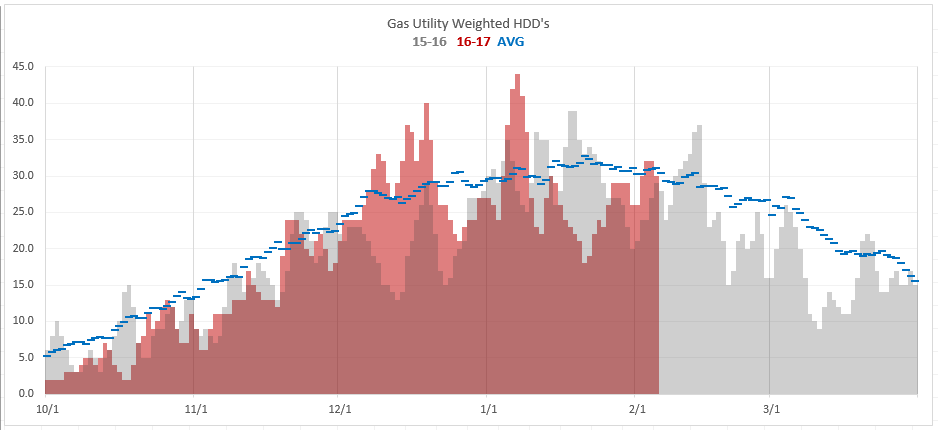
Gas prices have been struggling this month, with warm weather the chief culprit.  How is the current winter stacking up?  Well, the HDD count from Oct 1 through Jan 31 (next 4 day forecast assumed correct) puts this winter ahead of last winter by a 52 HDD margin.  

But we are behind the 20 year mean by a solid 299 HDD, which represents a tremendous amount of heating and electric load for natural gas.  I'm using the CPC numbers for gas-utility weighted HDDs in the calculation.  This suggests that gas could be very, very expensive had the weather been close to the mean, perhaps aiming toward a sub 1 TCF storage carryout in March/April.  That's a number that would light a fire, so to speak, under the Henry Hub forward strip.  

Here is the same data as a cumulation:

Thursday, January 26, 2017

Moderate Weather Outlook, Below Average Cold for JAN

Including the short term forecast from CPC, the total gas-utility-weighted HDDs for January look to come in about 10% below the 20 year average.


And the longer range 15 day forecast based on the GFS shows nothing far from normal:

Tuesday, January 24, 2017

Wednesday, January 11, 2017

Gas to Coal Switching: Reducing Gas Demand By More Than Expected

With each day that gas prices remained elevated compared to last year, the short term effects of hedging, contract commitments, and other temporary factors wear off, and we begin to see the fundamental economics for power generation.  Yesterday ERCOT reported it's fuel mix for December, and natural gas lost more than 1.3 BCFE per day to coal.  
In MISO, the numbers reveal themselves daily, and the impact is also more than 1 BCFE per day.  This suggests that the total impact of switching must be in the 5+ BCFE per day range nationwide.

Here's a look at the daily effects in MISO.  First of all, we see that the daily thermal power demand in December was comparable, year on year.  To wit, it was about 364 BCFE in Dec 2015, and 370 BCFE in 2016.  Close enough for government work:
 

That thermal generation demand was split between Natural Gas and Coal as follows:

Weather Forecast for Record Warmth Depresses Energy Demand

The two week outlook is for much below normal heating demand, as record high temps across the CONUS suggest that January will deliver very little power or home heating draws on natural gas.

The Climate Prediction Center shows a forecast through 11/17 that ends with record low gas-utility weighted HDDs:


And the Deltix forecast based on the GFS extends the warmth through the balance of the 15 day outlook:

Monday, January 9, 2017

Weather Outlook Brings Down Natural Gas

The cold weather was intense but it ends today for the foreseeable future.  The 15 day outlook shows a profound reversal to warmth, with only about 60% of normal HDDs forecast.

The CPC, including the 7 day forecast, shows some of the warmth, and brings us to about normal HDD's through mid month.  It's the outlook beyond that point that will take January down.


Last year, January was about average, here's a day by day look at last winter vs this winter so far.  Most of the warmth last year was concentrated in OCT-NOV-DEC:

Thursday, January 5, 2017

Weather Forecast: Four Days of Cold, Then Tropical

The CPC 7 day forecast shows the sharp and short cold blast:


And the GFS 15 day forecast depicts the pervasive warmth to follow:

Wednesday, January 4, 2017

Weather Forecast: Short Cold Blast Followed by Unseasonable Warmth

A surge of cold over the next 5 days will give way to a sharp warming trend, dropping the January average HDD count to below normal, and natural gas prices are reflecting that in spades.  

Here are the CPC gas-utility weighted totals, with their 7 day forecast through Jan 10th.


The longer range outlook shows the extreme return to tropical conditions in the CONUS, with HDD counts a bit above half their norms:

Monday, January 2, 2017

Weather Forecast: Cold Blast But Overall Average

December finished with average cold (872 HDD's vs 859 Average), and the outlook for the first half of January is for average weather as well, despite a 6 day period of intense cold beginning on Jan 4.

The NOAA Climate Prediction Center shows the cold in its 7 day forecast, after a mild 3 day period, which would take Gas Weighted HDD's to 252 through January 8th, against a 240 HDD historical average.


The Energy Metro Desk forecast based on the GFS shows a 15 day outlook with a 6 day cold period starting January 4th, then mostly below average heating demand in the latter portion (more volatile) of the forecast.  These last 5 days have been flipping hot/cold/hot in the last few model runs:

Tuesday, December 27, 2016

December Weather in Continental US Near Long Term Average, Jan Forecasts COLD

Assuming near term forecasts prove reliable, December will finish with about 878 Gas Utility Weighted Heating Degree Days, which is 19 above the 20 year average:


January forecasts look cold through week 1:

Monday, December 26, 2016

Weather Forecast: Extreme Cold Possible Day 11-14

December will end close to normal in terms of gas-weighted HDDs, according to the CPC:


But January 4th begins a period of potentially extreme cold.  It's too far distant to be reliable yet, but it may unsettle markets.  Here is a 15 day forecast based on the GFS model on 12/26 at 12Z: