Pages

Tuesday, January 3, 2017

Nuclear Power Output Steady, Slightly Below Last Winter

Nuclear power output in the continental US has been level over the past 9 days, about 1% below last year.  This is a change from the first part of winter, where output was outpacing '15.  However, this was the high water mark for nuclear power generation last year, and reactors began to go offline on Jan 8th, so we may again experience a surplus of electricity from nukes.


On a gas equivalent basis, it adds up to about 2 BCF less fossil fuel generation per week at the current level:

Alberta Natural Gas Production and Storage Tighten in 2017

Cooler weather and the end of the holidays has seen the Alberta TC Nova system reporting reduced production volumes and larger withdrawals from storage compared to last year in the early days of 2017.

High daily receipts, near 11.5 BCFD, were seen in the last week of 2016, but the first two days of January averaged 11.1 BCFD, down 0.4 BCFD.  Jan-Feb-Mar are seasonally high months, and the rising rig count should translate into some biennial daily high receipts in the coming weeks.


On the storage front, the withdrawals in the first two days of the year averaged over 1.2 BCF, more than double last year.  Two days does not a trend make, and weather is colder than normal, but the nightmare of last year's excess storage volumes looks unlikely to be repeated (Net withdrawals in Jan-Mar of last year were zero!):


Monday, January 2, 2017

EIA Reports OCT Natural Gas Production

On Friday The Energy Information Administration issued its Natural Gas Monthly Report for October.  Dry production was down 1.18 BCFD from the previous month, to 70.69 BCFD.  That is 3.43 BCFD below the same month in 2015.  


Dry production has been falling faster than gross production, because more liquids are being stripped out.  The percentage of gross production that is being removed as NGLs has been rising, and is up from about 5.3% a year ago to about 5.9% now:


Extent of Natural Gas Market Share Losses to Coal in Electricity Generation

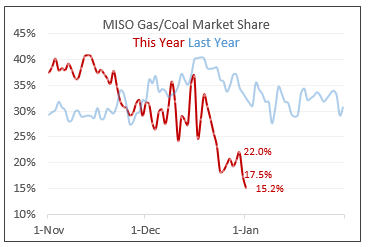
Here is the ongoing story of the (presumably price driven) loss of market share by natural gas in the power generation market, by the example of the MISO power region.  MISO represents 15-20% of the total national generation and load.

Coincident with the sharp rise in natural gas prices, gas began losing share to coal in mid-November of this year.  Low overall load will accentuate this trend to an extent, but the trend is visible through periods of both low and high load.  The lowest gas share of all came yesterday (Jan 1), with gas taking just 15.2% of the carbon fuel power market, to coal's 84.8%.  This compares to last year where the January gas share was near 35%.


In terms of absolute fuel volumes, we see the huge change.  Gas is now almost 2 BCFD behind last year, while coal is holding it's own:

Weather Forecast: Cold Blast But Overall Average

December finished with average cold (872 HDD's vs 859 Average), and the outlook for the first half of January is for average weather as well, despite a 6 day period of intense cold beginning on Jan 4.

The NOAA Climate Prediction Center shows the cold in its 7 day forecast, after a mild 3 day period, which would take Gas Weighted HDD's to 252 through January 8th, against a 240 HDD historical average.


The Energy Metro Desk forecast based on the GFS shows a 15 day outlook with a 6 day cold period starting January 4th, then mostly below average heating demand in the latter portion (more volatile) of the forecast.  These last 5 days have been flipping hot/cold/hot in the last few model runs: